The Mirror After Midnight: Why Mirrors Have Always Been Feared in Folklore
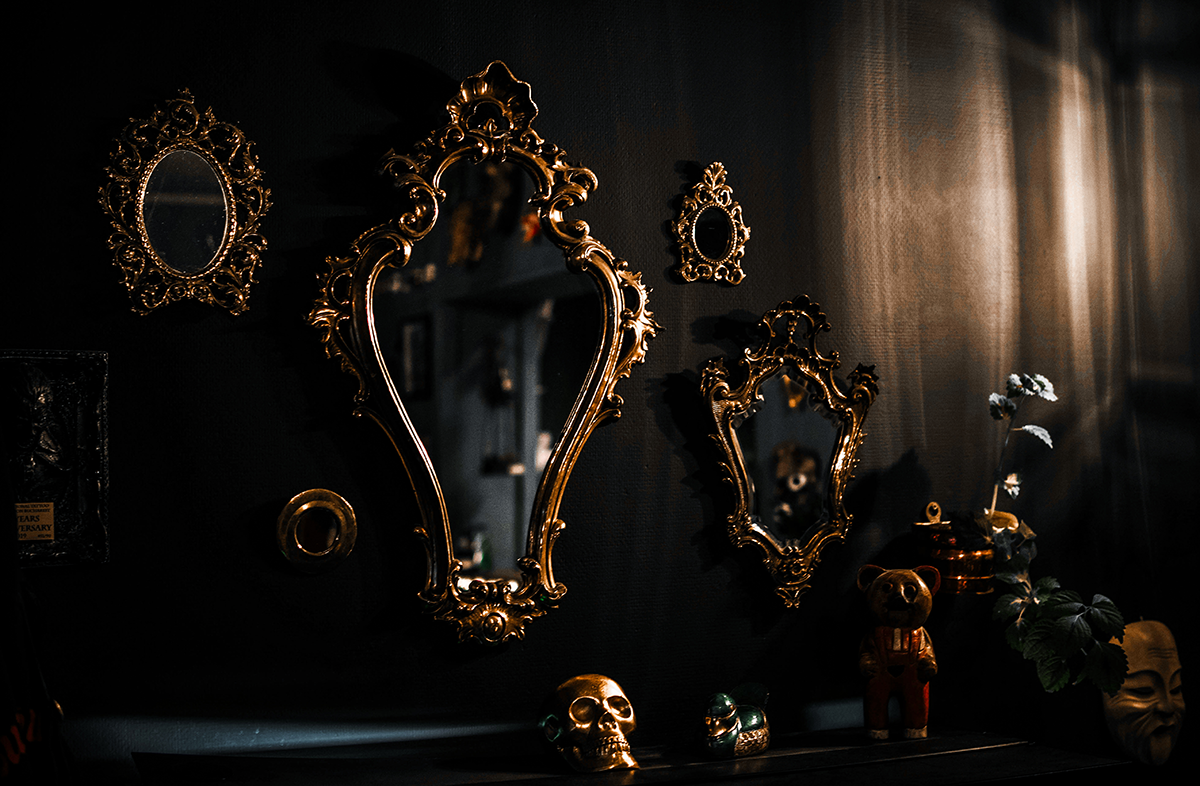
Something is unsettling about looking into a mirror in a darkened room.
During the day, it is an ordinary object. We glance into it while getting dressed, brushing our hair, or passing through the hallway. But at night, when the house grows quiet, and the only light comes from a candle or the moon outside, that familiar reflection can begin to feel strangely unfamiliar.
Perhaps it is the darkness gathering behind your shoulders. Perhaps it is the way your face seems to change in the flickering light. Or perhaps it is the uncomfortable feeling that, for just a moment, you might see something looking back that shouldn't be there.
For centuries, people have regarded mirrors with a mixture of fascination, suspicion, and fear. They have been used for divination, covered during periods of mourning, associated with wandering spirits, and blamed for everything from bad luck to stolen souls.
The history of mirror folklore is filled with warnings about reflections, death, and the strange possibility that the glass might reveal more than the world standing before it.
And as Halloween approaches, there is no better time to explore why something so ordinary became one of the most enduring objects of supernatural superstition.
Why Were Mirrors Considered Supernatural?
Long before mirrors became everyday household objects, seeing your own reflection was a rather extraordinary experience.
Ancient peoples encountered their reflections in still pools of water or polished surfaces made from stone and metal. Later, increasingly sophisticated mirrors allowed people to observe themselves with greater clarity.
But imagine encountering a perfect image of yourself without understanding exactly how it worked. The reflection moved when you moved, copied your expressions, and appeared to exist within a surface you could not enter.
It is easy to see how such an object could inspire spiritual interpretations.
In different cultures and periods, reflections became associated with identity, the soul, truth, vanity, and the supernatural. Some traditions treated mirrors as protective objects, while others regarded them as potentially dangerous.
The mirror was never simply a piece of glass. It became a symbol of the complicated relationship between appearance and reality.
Why Did People Cover Mirrors When Someone Died?
One of the most enduring mirror superstitions involves covering reflective surfaces after a death.
In some Victorian households, mirrors were covered as part of mourning customs. Similar practices have appeared in other cultural and religious contexts, although their meanings and origins differ.
In Jewish mourning tradition, for example, mirrors are commonly covered during shiva. Explanations emphasize turning attention away from personal appearance and toward mourning, reflection, and remembrance.
European folk beliefs sometimes offered a more supernatural explanation.
According to certain traditions, a mirror left uncovered after a death could interfere with the departed soul's journey. Some believed the spirit might become trapped within the reflection, while others feared that mirrors could attract or reveal an unwanted presence.
These beliefs were not universal, nor were they necessarily the official teachings of the religions practiced by those who observed them. They belonged to a broader world of household customs, local superstitions, and inherited warnings.
Still, the imagery is haunting.
A house falls quiet after someone dies. The furniture remains. Their belongings are exactly where they left them. But the mirrors are covered, as though the family has decided that certain things should not be reflected until the mourning has passed.
The Mirror as a Doorway Between Worlds
Doorways, crossroads, bridges, and shorelines have long fascinated people interested in magic and folklore because they represent boundaries between different states of existence.
Mirrors occupy a similar symbolic space.
They show us a world that appears almost identical to our own, yet remains permanently out of reach. The room in the reflection has depth, but no physical entrance. Everything is familiar, except that it is reversed.
In supernatural folklore, this visual contradiction helped inspire the idea that mirrors might serve as gateways between the living and the dead.
Some stories describe spirits appearing behind the observer. Others warn that prolonged gazing might reveal an unfamiliar face or an unsettling version of oneself.
The fear is rarely that the mirror will stop reflecting.
It is that the reflection might begin doing something independently.
That small possibility has haunted storytelling for generations.
Catoptromancy: The Ancient Practice of Mirror Divination
Long before modern horror films made haunted mirrors a familiar trope, reflective surfaces were used for divination.
The practice of seeking visions or answers through mirrors is known as catoptromancy, while divination through reflective surfaces more broadly may be described as scrying.
Ancient Greek sources describe forms of divination involving mirrors and water. One account associated with the sanctuary of Demeter at Patras describes a mirror lowered toward a spring and used in a ritual intended to reveal the prospects of someone who was ill.
Over the centuries, reflective divination appeared in different forms, from polished objects and dark mirrors to bowls of water.
Practitioners might gaze into the surface while contemplating a question, hoping that images, impressions, or symbolic visions would emerge.
In modern witchcraft, mirror scrying is often approached as a contemplative or intuitive practice rather than a reliable method of predicting events. The shifting patterns of light and reflection can become a focus for meditation, imagination, and personal symbolism.
Yet the old fascination remains. There is something compelling about looking into a surface that shows the familiar world while inviting the mind to imagine what might exist beyond it.
Bloody Mary and the Terror of the Bathroom Mirror
For many people, their first encounter with supernatural mirror folklore came through a childhood dare.
Stand in a dark bathroom. Look into the mirror. Repeat the name Bloody Mary, sometimes three times, sometimes more, depending on the version of the story.
Then wait.
The legend has circulated through generations of children, changing as it travels. Some versions promise the appearance of a ghostly woman. Others warn of scratches, screams, or something emerging from the glass.
The identity of Bloody Mary varies widely, and attempts to connect the legend to a single historical figure are often speculative.
What makes the ritual fascinating is how little it requires.
There are no elaborate tools or ceremonies. Just darkness, repetition, anticipation, and a mirror.
The experience also has a psychological explanation. Under dim lighting, prolonged staring at one's reflection can cause facial features to appear distorted or unfamiliar. Researchers have studied this phenomenon, sometimes called the strange-face-in-the-mirror illusion.
The mind begins struggling with incomplete visual information, and familiar features may seem to shift.
That explanation does not make the childhood ritual any less eerie.
If anything, it reveals how effectively folklore can transform an ordinary object into something frightening.
Why Do Mirrors Feel Different at Night?
Part of the fear surrounding mirrors comes from the way human perception changes in low light.
When illumination is poor, our visual system has less information to work with. Shadows become harder to interpret, reflections lose detail, and familiar shapes can appear unusual.
Candlelight adds another layer of uncertainty because the light itself is constantly moving.
A face reflected by a flickering flame may seem to change expression. A dark doorway behind you may look deeper than it really is. Movement elsewhere in the room can briefly appear in the glass without an immediately obvious source.
Our brains are especially sensitive to faces and unexpected movement, so even small distortions can become unsettling.
The supernatural interpretation may be folklore, but the discomfort itself is very real.
And perhaps that is why mirror legends have survived so successfully. They build upon an experience almost everyone recognizes.
Mirrors in Witchcraft and Protection Folklore
Not every magical tradition regards mirrors as dangerous.
In some modern witchcraft practices, mirrors are used symbolically for protection, reflection, truth, and redirecting unwanted intentions.
Small mirrors may be incorporated into protective charms or placed within ritual arrangements as symbols of boundaries and self-awareness.
Other practitioners use mirrors during meditation or shadow work, examining their own reflection as a way to explore identity, self-perception, and the parts of themselves they usually avoid acknowledging.
These contemporary practices vary widely and should not be mistaken for a single ancient tradition.
Still, the symbolism is compelling.
A mirror reflects what stands before it. It does not need to pursue, argue with, or absorb everything it encounters.
For someone working with personal boundaries, that becomes a useful metaphor. Not every emotion belongs to you, and not every outside influence deserves a place in your inner world.
Sometimes the most meaningful form of protection is learning what to acknowledge and what to leave outside.
A Simple Mirror Reflection Ritual for October
October is a natural time for introspection. As the evenings lengthen and Samhain approaches, many of us find ourselves drawn toward remembrance, endings, and the quieter parts of our spiritual lives.
A mirror can become a symbolic tool for that reflection, offering an opportunity to look beyond our outward appearance and consider what we've been carrying beneath the surface.
Begin by creating a comfortable space with a small mirror, your journal, and a candle. A candle from Wicked Obscura can help turn an ordinary evening into a moment of intentional stillness. Choose a scent that feels grounding or comforting, and allow its warm glow to mark the beginning of your ritual.
Place your candle safely beside your journal, away from the mirror and anything flammable. Spend a few moments observing your reflection in comfortable lighting, without trying to change or judge what you see.
Then consider these questions:
What part of myself have I been avoiding?
What have I outgrown but continue to carry?
Where am I allowing others' expectations to shape how I see myself?
What truth am I ready to acknowledge before the year turns toward winter?
Write whatever comes naturally. When you're finished, extinguish your candle and return the mirror to its usual place. Let that small action mark the end of your reflection.
The purpose is not to discover something supernatural inside the glass. It is to consider what your own reflection might teach you about the person standing before it.
A Little Candlelight for the Darker Season
Some rituals need nothing more than a quiet room, a moment of reflection, and the comforting glow of a candle. Explore our handcrafted candles and find one to accompany your autumn evenings. wickedobscura.com
The Folklore of Broken Mirrors and Seven Years of Bad Luck
Few mirror superstitions are as widely recognized as the belief that breaking a mirror brings seven years of bad luck.
The familiar explanation often connects this belief to ancient ideas about mirrors reflecting the soul and to the symbolic significance of seven-year cycles in Roman tradition.
However, the precise historical development of the superstition is difficult to establish, and popular accounts frequently repeat simplified origin stories.
What is clear is that broken mirrors have long carried unsettling symbolism.
A reflection that once appeared whole becomes fragmented into countless distorted pieces. Something that represented identity and self-recognition suddenly seems divided.
It is a powerful image, even without the promise of seven years of misfortune.
The broken mirror has become a symbol of disrupted identity, bad luck, fractured truth, and the fear that something familiar can change beyond recognition.
Perhaps that is why the superstition remains so memorable.
The Mirror and the Shadow Self
Of all the supernatural associations surrounding mirrors, perhaps the most enduring is their connection to the parts of ourselves we do not fully understand.
A mirror shows us our appearance, but it cannot tell us who we are.
It reflects the face we recognize while leaving everything beneath that surface invisible.
This contradiction makes mirrors particularly suited to stories about doubles, hidden identities, transformation, and the shadow self.
In Gothic literature and horror, the reflected image often becomes a way of exploring the fear that we might not know ourselves as well as we believe.
The stranger in the mirror is frightening precisely because it looks familiar.
And that may be the deepest reason mirrors continue to haunt our imaginations.
They force us to confront the possibility that what we see and what we understand are not always the same thing.
What Is Looking Back?
Mirrors have followed humanity through centuries of superstition, religious custom, divination, mourning, and storytelling.
They have been covered to honor the dead, consulted for visions, feared as supernatural doorways, and used as symbols of protection and self-knowledge.
Today, we understand the science of reflection. We know how light interacts with glass and why shadows can distort familiar images.
Yet a mirror in a darkened hallway can still make us hesitate.
Perhaps the enduring magic of mirror folklore is not proof that something lives behind the glass. Perhaps it is the reminder that humans have always been fascinated by the boundary between what we see and what we believe.
So the next time you pass a mirror late at night, you might find yourself glancing toward it a little longer than usual.
Not because you expect to see a ghost.
But because, for one brief moment, you understand why so many people once did.