
The Magic of Thunderstorms: Storm Folklore, Lightning, and Summer Witchcraft
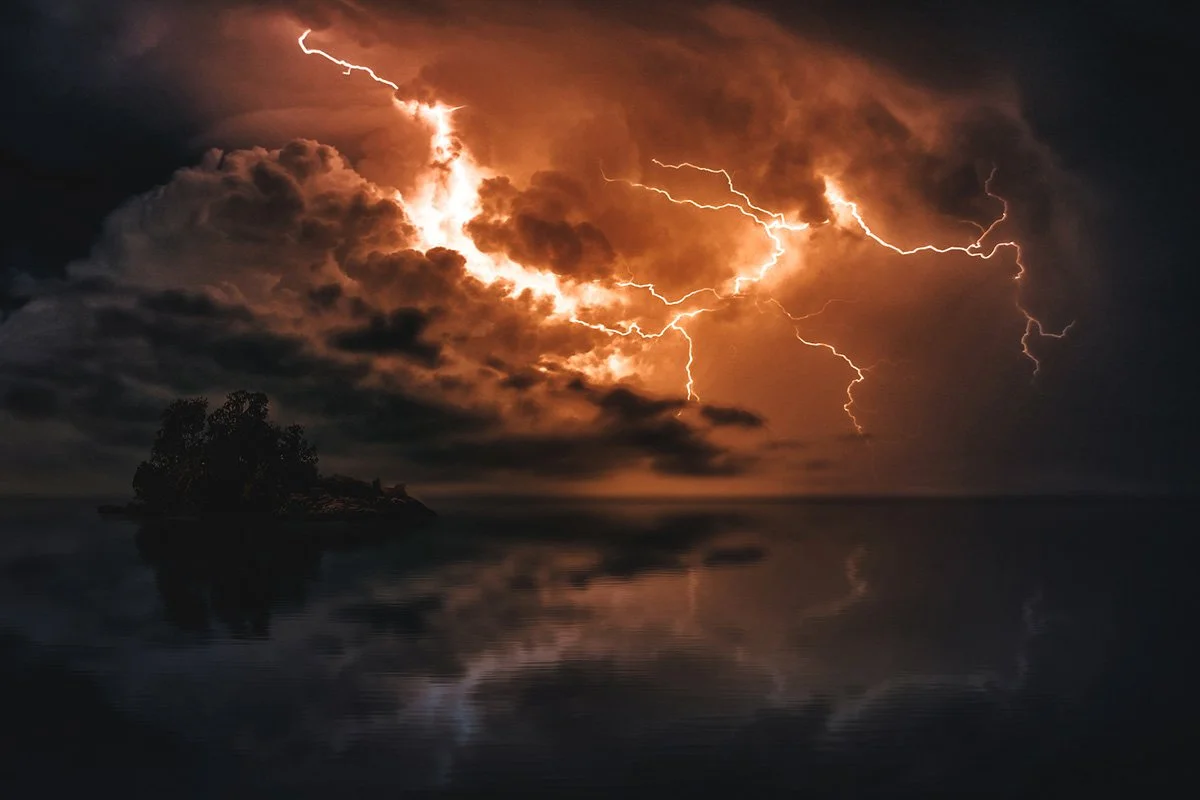
You can usually feel a summer storm before you see it.
The air grows heavy. Leaves turn restless. Birds quiet. The sky darkens into strange shades of gray and green, and somewhere in the distance comes the low rumble of thunder. Then the atmosphere breaks. Rain strikes hot pavement. Lightning splits the sky. Thunder rolls through the air with enough force to be felt inside the body. For a few moments, the entire landscape seems charged.
It is little wonder that thunderstorms have inspired mythology, superstition, divination, and magic for thousands of years. Before we understood the science behind lightning and thunder, storms were voices of gods, warnings from spirits, omens of change, and demonstrations of powers far greater than ourselves. Even now, knowing exactly how a thunderstorm forms does little to diminish its magic. Perhaps understanding the storm only gives us another reason to respect it.
Why Do Thunderstorms Feel So Powerful?
Thunderstorms bring several elemental forces together at once. There is water pouring from the sky. Wind moving through the landscape. Electricity flashing through the atmosphere. And thunder powerful enough to shake windows and vibrate through the chest. Few natural events make us feel quite so small.
Summer thunderstorms can feel particularly dramatic because warm, moisture-rich air helps create the unstable atmospheric conditions that produce them. A beautiful summer afternoon can transform surprisingly quickly into dark skies, wind, lightning, and heavy rain. That sudden shift has always made storms feel like threshold moments. The familiar world disappears beneath rain and darkness.
Then, sometimes only minutes later, the clouds part. The sunlight returns. Everything smells different.
Thunder Gods and Storm Deities Around the World
When ancient people heard thunder rolling across the sky, many interpreted it as the movement or voice of something divine. Storm gods appear throughout mythology.
In Norse tradition, Thor wielded the hammer Mjölnir and was associated with thunder, lightning, strength, and protection. The ancient Greeks looked toward Zeus, ruler of the Olympian gods, whose thunderbolts represented divine authority and power. Among the ancient Slavic peoples, Perun was associated with thunder, lightning, oak trees, warfare, and protection. In Yoruba tradition, Shango, or Ṣàngó, is powerfully associated with thunder and lightning. The Hindu god Indra is connected with storms, rain, thunder, and the life-giving waters necessary for the land.
Across continents and cultures, people looked toward the same turbulent sky and found divine power within it. Thunder was rarely insignificant. It meant something.
Lightning as a Symbol of Sudden Revelation
There is perhaps no natural symbol more immediate than lightning. It appears without warning, illuminating an entire landscape for only a fraction of a second. Then darkness returns.
Because of this, lightning has become associated with revelation, divine intervention, destruction, inspiration, and sudden transformation. There is something almost divinatory about it. For one brilliant instant, everything becomes visible. Spiritually, lightning can symbolize those moments in life when understanding arrives suddenly.
A realization. A truth. A decision you can no longer avoid. Not every transformation happens gradually. Sometimes the sky simply cracks open.
Thunderstorm Folklore and Protection Magic
Because thunderstorms could destroy crops, ignite buildings, kill livestock, and threaten entire communities, people developed countless customs intended to protect themselves.
Bells have particularly fascinating connections with storm folklore.
Across parts of medieval and early modern Europe, church bells were sometimes rung during approaching storms. The practice became connected with beliefs that consecrated bells could drive away destructive weather or the harmful spiritual forces believed to accompany it.
People also turned to protective plants, religious objects, iron, prayers, and household charms when storms approached. The specific traditions differed by place and period, but the intention remained remarkably familiar: Protect the home. Protect the harvest. Protect the people inside. Storm folklore reminds us how intimately our ancestors lived with weather. A storm was not something happening outside a window. It could determine whether a community ate.
The Oak and the Thunderstorm
Oak trees hold strong associations with several Indo-European thunder deities, including Zeus, Jupiter, Thor, and Perun. The connection may seem mysterious until you consider the tree itself. Oaks are tall, powerful, long-lived, and capable of dominating the landscapes where they grow. Tall trees are also vulnerable to lightning strikes.
Seeing lightning strike an enormous oak must have been an extraordinary sight to ancient observers. Over time, the oak became associated with strength, endurance, divine power, and protection. Even today, oak symbolism carries that feeling of something capable of standing through the storm.
What Is Storm Magic?
In modern witchcraft, storm magic generally refers to spiritual or magical practices inspired by the energy and symbolism of storms.
Storms may be associated with:
transformation
release
courage
emotional clearing
sudden change
protection
personal power
breaking stagnant patterns
Storm magic does not require standing outside beneath lightning. In fact, please don't.
The safest way to work with storm energy is through symbolism, observation, meditation, journaling, or practices performed safely indoors. Nature does not need us to physically enter danger for us to honor its power. Respect is part of the ritual.
What Is Storm Water?
Some modern practitioners collect rainwater during thunderstorms and refer to it as storm water.
Symbolically, it may be used in practices associated with courage, transformation, clearing, boundaries, or breaking through stagnant energy.
But there is an important practical distinction between magical symbolism and physical safety.
Rainwater can collect bacteria, pollutants, chemicals, animal waste, and contaminants from roofs or collection surfaces. Stormwater should not automatically be considered safe to drink, use in food, apply to the body, or give to pets.
If you choose to collect it for symbolic purposes, keep it clearly labeled and use it only in ways that do not require ingestion or skin contact. You can also skip collecting water entirely. The storm itself is enough.
A Safe Summer Storm Ritual
When a thunderstorm approaches, find a safe place indoors away from windows. Turn off some of the distractions around you. Listen.
Notice how the atmosphere changes. Feel the thunder moving through the building. Watch the shifting light from a safe distance. Then take out your journal. Write down something in your life that feels stagnant.
Ask yourself:
What needs to move?
What truth have I been avoiding?
What am I ready to stop carrying?
Where do I need the courage to create change?
When the storm passes, return to what you wrote. Notice whether anything feels different. You do not need to command the storm. Sometimes magic is simply allowing nature to remind you that movement is inevitable.
The Strange Calm After a Storm
Perhaps the most magical part of a thunderstorm happens after it leaves. The air cools. Water hangs from leaves. Birdsong slowly returns. The world feels temporarily washed clean. Storms remind us that disruption and renewal are often connected. Something can be chaotic without being meaningless. Something can shake us without destroying us. And sometimes clearing requires noise.
What Thunderstorms Can Teach Us
We spend enormous amounts of energy trying to keep life predictable. We create schedules. We make plans. We build routines. Then a storm rolls across the horizon and reminds us that nature has never promised certainty. There is humility in that realization. Storms teach us that change can arrive quickly. They remind us that power does not always look gentle.
They show us that darkness can pass as suddenly as it arrived. And they remind us that we do not have to control every force we encounter. Some things are meant to be witnessed.
Humans have watched thunderstorms since long before we had words to describe electricity.
We turned thunder into gods. Lightning into omens. Rain into blessing. And storms into stories.
Science has explained what happens inside those enormous clouds, but it has never taken away their ability to inspire awe. Perhaps that is the real spiritual meaning of thunderstorms. They remind us that understanding something does not make it ordinary. The next time the summer sky begins to darken, find somewhere safe and listen.
The storm has been telling stories for thousands of years.